
History of Cagliari
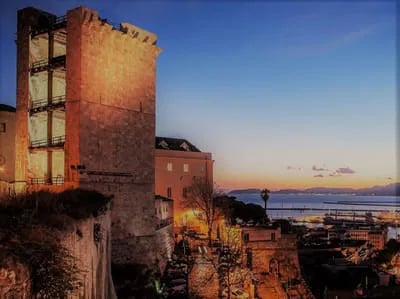
“A naked jewel of amber that suddenly opens, like a rose, in the depths of the wide inlet.” (D.H. Lawrence)
Thus, in the 1920s, the English novelist D.H. Lawrence described Cagliari, a city of sun, stone, and sea.
Since then, the island's capital has only partially changed its appearance, maintaining its ancient heart intact alongside the new, modern neighborhoods that have surrounded it since the post-war period.
Situated in a privileged position thanks to the presence of the sea, hills, and lagoons, Cagliari is the result of a history spanning thousands of years that has left its marks and traces throughout its territory; signs and traces more or less visible, more or less immediate, but all testifying to the presence of the men who have passed through here.
Numerous peoples have passed through or remained in Cagliari: Phoenicians, Romans, Vandals, Byzantines, Pisans, Genoese, Aragonese and Catalans, Spanish, Austrians, Piedmontese.
Everyone left something behind, which we can trace today in the buildings, the streets, the precious works of art preserved in churches and museums, in their names, their habits, their language.